Saturday, 20 June 2015

Coe's Chalk-pit, Bramford, Suffolk 1925

BGS Image ID: P202970
Coe's Chalk-pit, Bramford, Suffolk, 1 1/4 m. N. of railway-station. Looking E. General view of pit. The succession shown is quadratus-chalk, mucronata-chalk (uppermost 30 ft.), Thanet Beds, Reading Beds, Red Crag (?), glacial sands.

Posted by Bob McIntosh

Tuesday, 2 June 2015

Agglomerate, Mortonhall Quarry


Agglomerate. From neck; rhyolitic matrix. Mortonhall Quarry, near Buckstone. The first  of c 17,000 photographs of rock specimens from the BGS Systematic Series captured and processed by BGS volunteers in Edinburgh.

The Systematic Series is arranged by Geological Survey 1"/1:50,000 map sheet area. Representative rocks from each sheet were collected or drawn from other collections to make a teaching collection for new Survey field geologists.

Sunday, 19 April 2015

Working Portland Stone

Easton, Bath and Portland Stone Firms, Ltd., Portland. General view of mason's workshop in Portland Stone works. Works of Bath and Portland Stone Firms, Ltd. 1930.
BGS Image ID: P023985
Easton, Bath and Portland Stone Firms, Ltd., Portland. General view of mason's workshop in Portland Stone works. Works of Bath and Portland Stone Firms, Ltd. 1930.

Easton Quarry, Isle of Portland, Dorset. There are several quarries in the Easton area working the white freestone limestones known as Portland Stone. In the early 19th century, when many of the quarries were still in the hands of the Crown, they were principally worked by convict labour. Large stone columns are a feature of most classical stone buildings and in later times many British architects copied such classical themes. Portland Stone proved to be ideal for this purpose because the beds of limestone are quite thick. Here a section of stone column is being turned on lathe at the works of the Bath & Portland Stone Company. The section is of 4 ft. diameter, and is one of five constituting a column 25 ft. high. As Portland Stone seems to be less affected by pollution than other United Kingdom limestones it has been widely used in London, particularly since the early 19th century e.g. Custom House, St. Paul's Cathedral, The Bank of England, Whitehall and Downing Street.
BGS Image ID: P204941
Easton Quarry, Isle of Portland, Dorset. There are several quarries in the Easton area working the white freestone limestones known as Portland Stone. In the early 19th century, when many of the quarries were still in the hands of the Crown, they were principally worked by convict labour. Large stone columns are a feature of most classical stone buildings and in later times many British architects copied such classical themes. Portland Stone proved to be ideal for this purpose because the beds of limestone are quite thick. Here a section of stone column is being turned on lathe at the works of the Bath & Portland Stone Company. The section is of 4 ft. diameter, and is one of five constituting a column 25 ft. high. As Portland Stone seems to be less affected by pollution than other United Kingdom limestones it has been widely used in London, particularly since the early 19th century e.g. Custom House, St. Paul's Cathedral, The Bank of England, Whitehall and Downing Street.

Easton, Bath and Portland Stone Firms, Ltd., Portland. Hand-carving in Portland Stone. Only straightforward work such as that on ashlar and on mouldings is carried out by machine. Finer work is all done by hand. Works of Bath and Portland Stone Firms, Ltd.
BGS Image ID: P204947
Easton, Bath and Portland Stone Firms, Ltd., Portland. Hand-carving in Portland Stone. Only straightforward work such as that on ashlar and on mouldings is carried out by machine. Finer work is all done by hand. Works of Bath and Portland Stone Firms, Ltd.

Easton, Bath and Portland Stone Firms, Ltd., Portland. Travelling crane lifting block of masonry in Portland Stone. Works of Bath and Portland Stone Firms, Ltd.
BGS Image ID: P204950
Easton, Bath and Portland Stone Firms, Ltd., Portland. Travelling crane lifting block of masonry in Portland Stone. Works of Bath and Portland Stone Firms, Ltd.

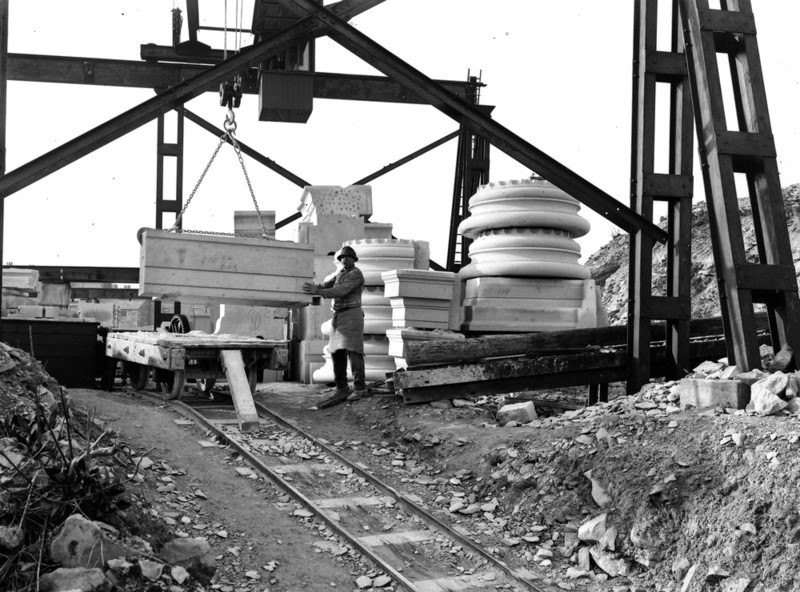
Easton, Bath and Portland Stone Firms, Ltd., Portland. Stack of finished masonry in Portland Stone. The diameter of sections of fluted columns in foreground is 4 ft. Works of Bath and Portland Stone Firms, Ltd.
BGS Image ID: P204951
Easton, Bath and Portland Stone Firms, Ltd., Portland. Stack of finished masonry in Portland Stone. The diameter of sections of fluted columns in foreground is 4 ft. Works of Bath and Portland Stone Firms, Ltd.

Posted by Bob McIntosh

Monday, 6 April 2015

China-clay works, Devon and Cornwall

Lantern China-clay Works, near Rescorla, St. Austell. Looking SW. View of lower part of clay-pit. This photograph, taken down in the pit, shows the stream of water, by which the clay is washed out of the decomposed granite travelling down the stope and from thence through the sand-pits to the 'bottom hole launder', whence it is pumped to the surface. The sand-pits are only partly visible in the photograph, but the annexed diagram shows the direction of flow of the water.
BGS Image ID: P200171
Lantern China-clay Works, near Rescorla, St. Austell. Looking SW. View of lower part of clay-pit. This photograph, taken down in the pit, shows the stream of water, by which the clay is washed out of the decomposed granite travelling down the stope and from thence through the sand-pits to the 'bottom hole launder', whence it is pumped to the surface. The sand-pits are only partly visible in the photograph, but the annexed diagram shows the direction of flow of the water.

Hendra Downs China-clay Works, St. Dennis. Looking N. Team and waggon with load of clay.
BGS Image ID: P200203

Hendra Downs China-clay Works, St. Dennis. Looking N. Team and waggon with load of clay.
China clay workings, Great Pit, Lee Moor, south Dartmoor. General view of china clay-pit showing systems for disposal of waste sand; (1) right, old inclined railway to large 'burrow', and (2) left, new covered conveyor belt to small burrow (sited on ground having low clay yield). China clay is formed by the kaolinization of granite, a process of late hydrothermal alteration where acid solutions moved along the joints in the granite and caused the plagioclase feldspars to be converted to kaolinite. The name kaolin comes from the mountain Kauling in China where the material was discovered. Large scale exploitation began in the 18th century. Recently the industry has become intensively mechanized.
BGS Image ID: P2009710
Old photograph number: A09799   1962
China clay workings, Great Pit, Lee Moor, south Dartmoor. General view of china clay-pit showing systems for disposal of waste sand; (1) right, old inclined railway to large 'burrow', and (2) left, new covered conveyor belt to small burrow (sited on ground having low clay yield). China clay is formed by the kaolinization of granite, a process of late hydrothermal alteration where acid solutions moved along the joints in the granite and caused the plagioclase feldspars to be converted to kaolinite. The name kaolin comes from the mountain Kauling in China where the material was discovered. Large scale exploitation began in the 18th century. Recently the industry has become intensively mechanized.

Posted by Bob McIntosh

Sunday, 15 March 2015

Odd rocks of the Scilly Isles

BGS Image ID: P241716
The 'Loaded Camel' St. Mary's.


BGS Image ID: P241720
The 'Nag's Head' St. Agnes.


BGS Image ID: P241717
The 'Punch bowl' St Agnes.

A series of photographs taken by R.H. Preston illustrating weathering of granite. The photographs were donated to the British Association for the Advancement of Science Collection. Photographs are dated 1895.

See also 'The Drum Rock'
Posted by Bob McIntosh

Monday, 23 February 2015

Geology in a tin - Campbeltown Sandstone

This specimen is probably from the Campbeltown Sandstone, of Carboniferous Limestone Coal Group age. It was worked by the Campbeltown Coal Company Limited at the Argyll Colliery, Machrihanish, as a sandstone that was ground for furnace hearth sands. British Geological Survey Petrology Collection sample number MC 7420. The sandstone was worked by stoop and room and in places large galleries were opened up to work the full c. 63 feet thick sandstone. The rock was first holed and then the blasting charges were inserted some way up the working face. The rock was crushed at the pit but not washed. The Campbeltown sand was used as a substitute for Belgian sand for lining the Siemens-Martin steel furnaces; also for steel and iron castings and for glass making. In 1918 it was reported to be transported by light railway to Campbeltown, shipped to Glasgow, places on the Ayrshire seaboard, Workington, Cumberland and a certain amount exported to Calcutta.
BGS Image ID: P527640

This specimen is probably from the Campbeltown Sandstone, of Carboniferous Limestone Coal Group age. It was worked by the Campbeltown Coal Company Limited at the Argyll Colliery, Machrihanish, as a sandstone that was ground for furnace hearth sands. British Geological Survey Petrology Collection sample number MC 7420. 

The sandstone was worked by stoop and room and in places large galleries were opened up to work the full c. 63 feet thick sandstone. The rock was first holed and then the blasting charges were inserted some way up the working face. The rock was crushed at the pit but not washed. The Campbeltown sand was used as a substitute for Belgian sand for lining the Siemens-Martin steel furnaces; also for steel and iron castings and for glass making. In 1918 it was reported to be transported by light railway to Campbeltown, shipped to Glasgow, places on the Ayrshire seaboard, Workington, Cumberland and a certain amount exported to Calcutta.

Posted by Bob McIntosh

Thursday, 19 February 2015

Sir Roderick Impey Murchison at the Museum of Practical Geology

Photograph. Written on the back of the photograph is ' Sir Roderick Murchison (restoration)'.
 BGS Image ID: P640912

Written on the back of the photograph is ' Sir Roderick Murchison (restoration)'.

It would be interesting to find out the story behind the mannequin - who was the wag who perpetrated this?

Museum of Practical Geology, Jermyn Street, London. c1855 -1900 GSM/MG/E/5.

Posted by Bob McIntosh

Wednesday, 28 January 2015

Photograph from the Frederic William Harmer collection. Above Runton Gap

Above Runton Gap, 3rd October 1907.  Two names noted Gottsche and Tietze. Photograph from the Frederic William Harmer collection.
BGS Image ID: P680269

Above Runton Gap, Norfolk, 3rd October 1907.  Two names noted Gottsche and Tietze. Photograph from the Frederic William Harmer collection.

Runton is the main outcrop of the type deposit of the Cromerian warm stage  the West Runton Freshwater Bed. The latter is highly fossiliferous containing remains of plants and trees, molluscs, fish, amphibians, large and small mammals and birds.

Probably Carl Christian Gottsche and Emil Ernst August Tietze, can anyone confirm?

Posted by Bob McIntosh

Wednesday, 7 January 2015

E.O. Teale collection - transport in East Africa

Wilson Airways aeroplane, E.O. Teale photograph collection

Travel in East Africa in the 1920s. By air, boat and motor car!
(a De Haviland Dragon  ID courtesy of Richard Holowka @RichHolowka)
Travel by boat, East Africa, 1920s

Travel by boat, East Africa
Travel by car East Africa 1920s. E.O. Teale Collection

Travel by car East Africa 1920s. E.O. Teale Collection

Travel by car East Africa 1920s. E.O. Teale Collection

Travel by car East Africa 1920s. 

The full E. O. Teale photograph collection can be found on Geoscenic

Posted by Bob McIntosh

Friday, 5 December 2014

On the manufacture of gun-flints, Memoir of the Geological Survey 1879.

Title page of: Memoir Geological Survey. England and Wales. On the manufacture of gun-flints, the method of excavating for flint, the age of Palaeolithic Man and the connexion between Neolithic art and the gun-flint trade by Sydney B.J. Skertchly. London : HMSO, 1879.

Title page of: Memoir Geological Survey. England and Wales. On the manufacture of gun-flints, the method of excavating for flint, the age of Palaeolithic Man and the connexion between Neolithic art and the gun-flint trade by Sydney B.J. Skertchly. London : HMSO, 1879. The memoir is an exhaustive account of the making of gun-flints at Brandon in Sussex.

The memoir is a regarded as a classic by modern day flint knappers.


Sample page showing a few of the wide range of gun-flints that were available at the time - all with interesting names such as Mixed Grey or Spotted Horse Pistol, Chalk-heeled Horse Pistol, Best Carbine, Solid Grey Musket etc.

Sample page showing descriptions of the thirty-three gun-flints that were available at the time. The gun-flints had interesting names such as Mixed Grey or Spotted Horse Pistol, Chalk-heeled Horse Pistol, Best Carbine, Solid Grey Musket etc. They were all made by eye, no measurements were involved.

Illustration showing knappers at work.

Illustration showing knappers at work. Flint was mined from chalk pits, each pit lasting from six to nine months. The miners sold the flints to the flint knappers by the 'jag' which is one cart-load about equal to a ton. 

To manufacture the gun-flints there were four processes:

Drying - flint would be dried outside in the summer but in the winter it was dryed around the fire indoors.

Quartering - a block of stone is taken and quartered - they may weigh a quarter of a hundredweight to two hundredweights.

Flaking - The most difficult process and requires great skill and 'nicety of judgement'.

Knapping - The final process of forming the flakes into gun-flints. A good flake will make four, and a very good one five flints. An average workman will knap 3,000 flints in a day of 12 hours. One man working from 4 a.m. until 11 p.m. made 24,000 in a week!

Illustration showing how a flint fractures to provide a series of flakes. Just one stage in the process of making gun-flints.

Illustration showing how a flint fractures to provide a series of flakes. Just one stage in the process of making gun-flints.

Watch a video on flint mining and knapping at Brandon in the 1930s and 1940s here  and here. Definitely worth watching!

Posted by Bob McIntosh