Showing posts with label Portland Stone. Show all posts

Sunday, 19 April 2015

Working Portland Stone

Easton, Bath and Portland Stone Firms, Ltd., Portland. General view of mason's workshop in Portland Stone works. Works of Bath and Portland Stone Firms, Ltd. 1930.
BGS Image ID: P023985
Easton, Bath and Portland Stone Firms, Ltd., Portland. General view of mason's workshop in Portland Stone works. Works of Bath and Portland Stone Firms, Ltd. 1930.

Easton Quarry, Isle of Portland, Dorset. There are several quarries in the Easton area working the white freestone limestones known as Portland Stone. In the early 19th century, when many of the quarries were still in the hands of the Crown, they were principally worked by convict labour. Large stone columns are a feature of most classical stone buildings and in later times many British architects copied such classical themes. Portland Stone proved to be ideal for this purpose because the beds of limestone are quite thick. Here a section of stone column is being turned on lathe at the works of the Bath & Portland Stone Company. The section is of 4 ft. diameter, and is one of five constituting a column 25 ft. high. As Portland Stone seems to be less affected by pollution than other United Kingdom limestones it has been widely used in London, particularly since the early 19th century e.g. Custom House, St. Paul's Cathedral, The Bank of England, Whitehall and Downing Street.
BGS Image ID: P204941
Easton Quarry, Isle of Portland, Dorset. There are several quarries in the Easton area working the white freestone limestones known as Portland Stone. In the early 19th century, when many of the quarries were still in the hands of the Crown, they were principally worked by convict labour. Large stone columns are a feature of most classical stone buildings and in later times many British architects copied such classical themes. Portland Stone proved to be ideal for this purpose because the beds of limestone are quite thick. Here a section of stone column is being turned on lathe at the works of the Bath & Portland Stone Company. The section is of 4 ft. diameter, and is one of five constituting a column 25 ft. high. As Portland Stone seems to be less affected by pollution than other United Kingdom limestones it has been widely used in London, particularly since the early 19th century e.g. Custom House, St. Paul's Cathedral, The Bank of England, Whitehall and Downing Street.

Easton, Bath and Portland Stone Firms, Ltd., Portland. Hand-carving in Portland Stone. Only straightforward work such as that on ashlar and on mouldings is carried out by machine. Finer work is all done by hand. Works of Bath and Portland Stone Firms, Ltd.
BGS Image ID: P204947
Easton, Bath and Portland Stone Firms, Ltd., Portland. Hand-carving in Portland Stone. Only straightforward work such as that on ashlar and on mouldings is carried out by machine. Finer work is all done by hand. Works of Bath and Portland Stone Firms, Ltd.

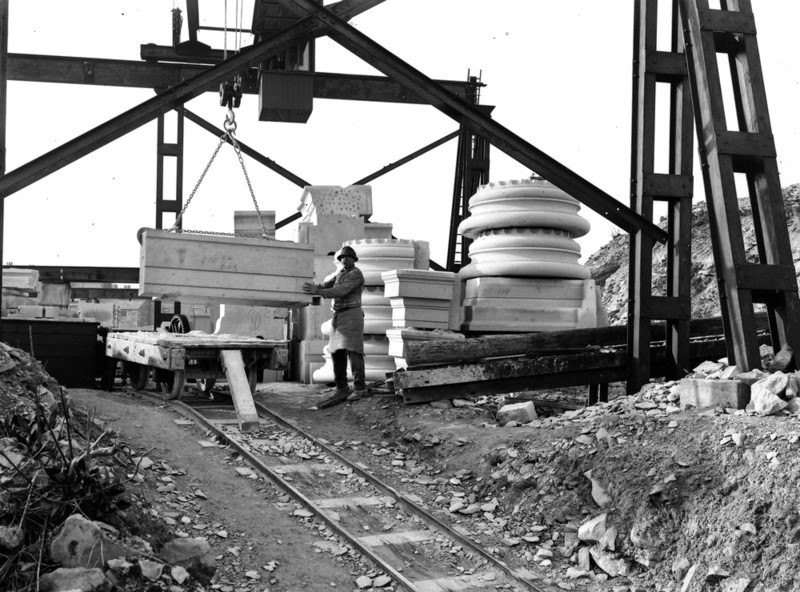
Easton, Bath and Portland Stone Firms, Ltd., Portland. Travelling crane lifting block of masonry in Portland Stone. Works of Bath and Portland Stone Firms, Ltd.
BGS Image ID: P204950
Easton, Bath and Portland Stone Firms, Ltd., Portland. Travelling crane lifting block of masonry in Portland Stone. Works of Bath and Portland Stone Firms, Ltd.

Easton, Bath and Portland Stone Firms, Ltd., Portland. Stack of finished masonry in Portland Stone. The diameter of sections of fluted columns in foreground is 4 ft. Works of Bath and Portland Stone Firms, Ltd.
BGS Image ID: P204951
Easton, Bath and Portland Stone Firms, Ltd., Portland. Stack of finished masonry in Portland Stone. The diameter of sections of fluted columns in foreground is 4 ft. Works of Bath and Portland Stone Firms, Ltd.

Posted by Bob McIntosh

Friday, 29 March 2013

Raising a block of Portland Stone from the Seacombe Quarry, Worth Maltravers, Dorset


Raising a block of Portland Stone from the Seacombe Quarry, Worth Matravers, Dorset.
BGS image ID: P023962

Raising a block of Portland Stone from the Seacombe Quarry, Worth Matravers, Dorset. The block, cut from the face of the quarry by the plug and feathers method weighs about 4.5 tons. One of the advantages that the Portland Stone quarries have over other producers is the large size of the limestone blocks that can be produced. The limestone quarries of Portland Bill have been in operation since Roman times. The characteristic white limestones which have proved to be extremely durable, even in the most polluted of urban environments, can be found in important buildings in all major cities and most large towns in the United Kingdom.

The Isle of Purbeck, though perhaps more famous as the source of the fossiliferous Purbeck Marble, is also a major producer of Portland Stone. The same succession of worked beds - Basebed, Whitbed and Roach - that outcrop in the Isle of Portland extends into the Purbeck area. Many of the quarries in the Isle of Purbeck were sited along the coastal cliffs and the stone was worked via an extensive series of underground galleries.

BGS Old photograph number A4985
Date of photograph: 1930.
Photographer: J. Rhodes

Bob McIntosh