Showing posts with label quarry. Show all posts

Sunday, 19 April 2015

Working Portland Stone

Easton, Bath and Portland Stone Firms, Ltd., Portland. General view of mason's workshop in Portland Stone works. Works of Bath and Portland Stone Firms, Ltd. 1930.
BGS Image ID: P023985
Easton, Bath and Portland Stone Firms, Ltd., Portland. General view of mason's workshop in Portland Stone works. Works of Bath and Portland Stone Firms, Ltd. 1930.

Easton Quarry, Isle of Portland, Dorset. There are several quarries in the Easton area working the white freestone limestones known as Portland Stone. In the early 19th century, when many of the quarries were still in the hands of the Crown, they were principally worked by convict labour. Large stone columns are a feature of most classical stone buildings and in later times many British architects copied such classical themes. Portland Stone proved to be ideal for this purpose because the beds of limestone are quite thick. Here a section of stone column is being turned on lathe at the works of the Bath & Portland Stone Company. The section is of 4 ft. diameter, and is one of five constituting a column 25 ft. high. As Portland Stone seems to be less affected by pollution than other United Kingdom limestones it has been widely used in London, particularly since the early 19th century e.g. Custom House, St. Paul's Cathedral, The Bank of England, Whitehall and Downing Street.
BGS Image ID: P204941
Easton Quarry, Isle of Portland, Dorset. There are several quarries in the Easton area working the white freestone limestones known as Portland Stone. In the early 19th century, when many of the quarries were still in the hands of the Crown, they were principally worked by convict labour. Large stone columns are a feature of most classical stone buildings and in later times many British architects copied such classical themes. Portland Stone proved to be ideal for this purpose because the beds of limestone are quite thick. Here a section of stone column is being turned on lathe at the works of the Bath & Portland Stone Company. The section is of 4 ft. diameter, and is one of five constituting a column 25 ft. high. As Portland Stone seems to be less affected by pollution than other United Kingdom limestones it has been widely used in London, particularly since the early 19th century e.g. Custom House, St. Paul's Cathedral, The Bank of England, Whitehall and Downing Street.

Easton, Bath and Portland Stone Firms, Ltd., Portland. Hand-carving in Portland Stone. Only straightforward work such as that on ashlar and on mouldings is carried out by machine. Finer work is all done by hand. Works of Bath and Portland Stone Firms, Ltd.
BGS Image ID: P204947
Easton, Bath and Portland Stone Firms, Ltd., Portland. Hand-carving in Portland Stone. Only straightforward work such as that on ashlar and on mouldings is carried out by machine. Finer work is all done by hand. Works of Bath and Portland Stone Firms, Ltd.

Easton, Bath and Portland Stone Firms, Ltd., Portland. Travelling crane lifting block of masonry in Portland Stone. Works of Bath and Portland Stone Firms, Ltd.
BGS Image ID: P204950
Easton, Bath and Portland Stone Firms, Ltd., Portland. Travelling crane lifting block of masonry in Portland Stone. Works of Bath and Portland Stone Firms, Ltd.

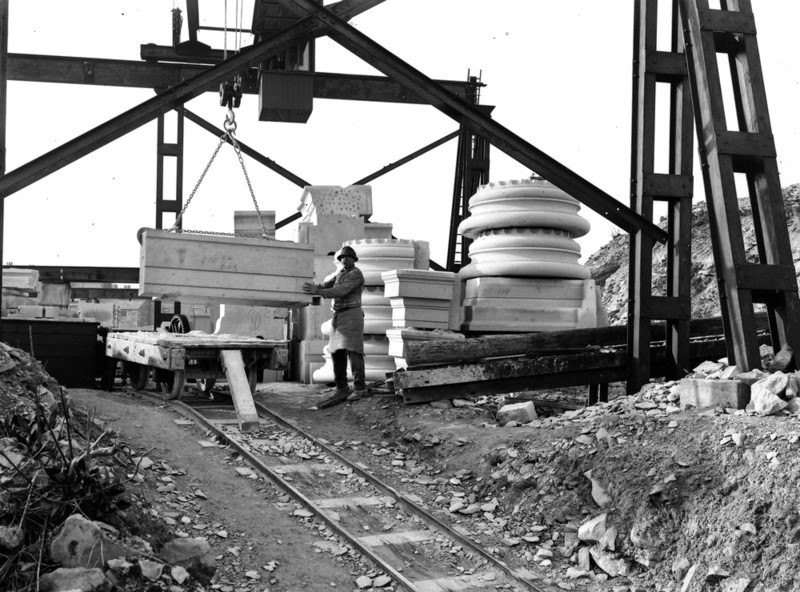
Easton, Bath and Portland Stone Firms, Ltd., Portland. Stack of finished masonry in Portland Stone. The diameter of sections of fluted columns in foreground is 4 ft. Works of Bath and Portland Stone Firms, Ltd.
BGS Image ID: P204951
Easton, Bath and Portland Stone Firms, Ltd., Portland. Stack of finished masonry in Portland Stone. The diameter of sections of fluted columns in foreground is 4 ft. Works of Bath and Portland Stone Firms, Ltd.

Posted by Bob McIntosh

Monday, 3 November 2014

Penmaenmawr Mountain Top Quarry

Penmaenmawr Mountain Top Quarry. Conveyors down to loading pier.
BGS Image ID: P539567

Penmaenmawr Mountain Top Quarry. Conveyors down to loading pier.

Penmaenmawr Mountain Top Quarry. Ship loading jetty - some of output went by boat to London.
BGS Image ID: P539617

Ship loading jetty - some of output went by boat to London.

Penmaenmawr Mountain Top Quarry. Drilling shot holes
BGS Image ID: P539574

Drilling shot holes.

Images from the Hugh O'Neill collection. Photographs taken c 1960-61.

Posted by: Bob McIntosh

Monday, 9 December 2013

Ballochmyle Quarry, Mauchline. Ayrshire, 1921

Ballochmyle Quarry, Mauchline. Ayrshire. New Red Sandstone (Permian) red desert sandstones showing large-scale aeolian (wind-blown) dune-bedding. The huge size of the quarry is indicated by the scale of the quarrymen – the quarry is often over 64 m deep. Access to the working face by ladder is clearly seen. Health & safety was not what is today! Large blocks are lifted by crane powered by a vertical steam boiler. The sandstone consists of well-sorted, mostly rounded and frosted sand grains. They are red in colour due to a coating of haematite, an iron oxide.
BGS Image ID: P000071
Ballochmyle Quarry, Mauchline. Ayrshire. New Red Sandstone (Permian) red desert sandstones showing large-scale aeolian (wind-blown) dune-bedding. The huge size of the quarry is indicated by the scale of the quarrymen – the quarry is often over 64 m deep. Access to the working face by ladder is clearly seen. Health & safety was not what is today! Large blocks are lifted by crane powered by a vertical steam boiler. 

Date of image: 1921.

A sample of Ballochmyle sandstone from the National Building Stone Collection held at the British Geological Survey. Econ. 7471.
BGS Image ID: P753273
A sample of Ballochmyle sandstone from the National Building Stone Collection held at the British Geological Survey. Econ. 7471. The sandstone consists of well-sorted, mostly rounded and frosted sand grains. They are red in colour due to a coating of haematite, an iron oxide.

Emily Tracey
Building Stones Conservation Specialist. 
Visit the new building stones web pages 

Monday, 2 September 2013

Quarrying Caithness Flagstones, Stonegunn Quarry, c. 1910

Stonegunn Quarry, 4.8 km. south-east of Thurso. Caithness. Method of levering the flagstones. The horizontal bed of rock is first split using chisels hammered in with a sledgehammer. It is then levered off the bedding plane with a crowbar. A quarryman in dress of the time (c.1910) is clearly seen. The rock is Devonian (Old Red Sandstone) Caithness Flagstones. After splitting each flag is taken away by means of crane and is subjected to preliminary squaring.
BGS Image ID: P000022
Stonegunn Quarry, 4.8 km. south-east of Thurso. Caithness. Method of levering the flagstones. The horizontal bed of rock is first split using chisels hammered in with a sledgehammer. It is then levered off the bedding plane with a crowbar. A quarryman in dress of the time (c.1910) is clearly seen. The rock is Devonian (Old Red Sandstone) Caithness Flagstones. After splitting each flag is taken away by means of crane and is subjected to preliminary squaring.

Bob McIntosh

Sunday, 14 April 2013

Granite dressing sheds at De Lank quarries, St. Breward, Cornwall


Granite dressing sheds at De Lank quarries, St. Breward, Cornwall. Looking west-north-west. The De Lank quarries work the coarse-grained, grey granites of Bodmin Moor.
BGS image ID: P000510

Granite dressing sheds at De Lank quarries, St. Breward, Cornwall. Looking west-north-west.
The De Lank quarries work the coarse-grained, grey granites of Bodmin Moor. The extensive range of granite products on display in the De Lank dressing sheds is a tribute to the skills of the masons who originally worked this hard intractable stone with only limited hand tools. Since the 15th century granite has been used in buildings as hewn blocks and cut into ashlar. Also, up to about 1800, granite was taken from the vast amounts of surface debris. More recently there was demand for building blocks of ground 'reconstituted' granite where planning regulations demanded the use of stone. The De Lank Quarries near Bodmin produced a light grey granite. Large blocks were obtained from the quarries because of the regular jointing. The Eddystone, Beachy Head and Small Rock lighthouses are among many buildings constructed from De Lank granite.

Old BGS photograph number A00517

Date of image: 1907

Bob McIntosh

Friday, 5 April 2013

Hantergantick Quarry, Cornwall. Thermal lance demonstration.

Hantergantick Quarry, Cornwall. Thermal lance demonstration.
BGS image ID: P539881
Hantergantick Quarry. Jet cutting demonstration using a thermal lance to cut granite with heat and sound energy. Early 1960s. Note gas cylinders in the background. Hugh O'Neill Collection.

The temperature is believed to reach 3000 degrees C.

Bob McIntosh