Tuesday, 24 December 2013

Iguanodon, Elephant, Bison, Rhinoceros and other saurian remains 1911.

Thigh bone of Iguanadon, Wealden Beds, Brook, Isle of Wight. E.T. Martin

Thigh bone of Iguanodon, Wealden Beds, Brook, Isle of Wight. E.T. Martin.


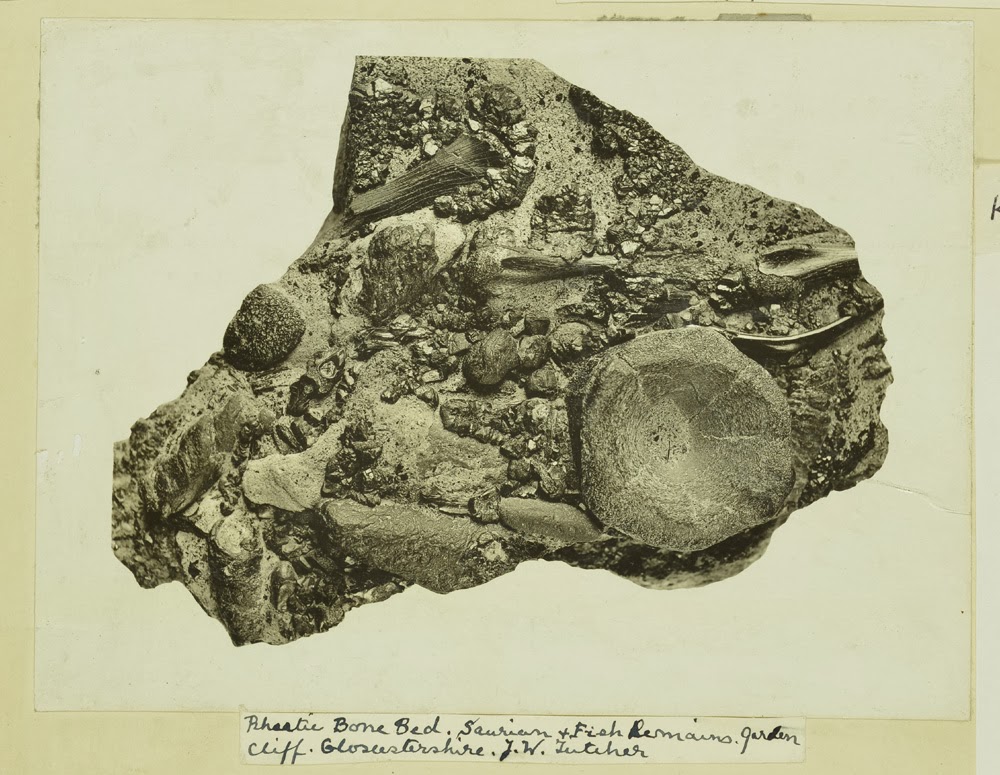
Rhaetic Bone Bed. saurian and fish remains. Garden Cliff. Gloucestershire. J.W. Fletcher.

Rhaetic Bone Bed. saurian and fish remains. Garden Cliff. Gloucestershire. J.W. Fletcher.

Elephant and Rhinoceras. Barrington Beds. Cambridgeshire. H.M. Krusin 15.6.1911

Elephant and Rhinoceros. Barrington Beds. Cambridgeshire. H.M. Krusin 15.6.1911

Bison, Elephant and Rhinoceras, barrington beds. Barrington Cambridgeshire 15.6.1911

Bison, Elephant and Rhinoceros, Barrington Beds. Barrington Cambridgeshire 15.6.1911

Images from the Geologists' Association 'Carreck Archive' held at the British Geological Survey

Bob McIntosh

Saturday, 21 December 2013

Searching for Palaeolithic implements, Milton Street Gravel Pits, Kent. 1908.

Caption: Workmen with rods for searching for Palaeolithic implements, Milton Street Gravel Pits, Kent. T.W. Reader 23.5.08. [1908]

Caption: Workmen with rods for searching for Palaeolithic implements, Milton Street Gravel Pits, Kent. T.W. Reader 23.5.08. [1908]


Caption: Some members examine the Flint Implement collection of Mr. Treacher.  [Llewellyn Treacher] T.R.W. 25.6.10 [1910]

Caption: Some members examining the Flint Implement collection of Mr. Treacher.  [Llewellyn Treacher] T.R.W. 25.6.10 [1910]

Photographs are from the Geologists' Association 'Carreck Archive' on deposit at the British Geological Survey.

Bob McIntosh


Tuesday, 10 December 2013

Christmas card from J V Harrison, 1930

Christmas card from J V Harrison
BGS image ID: P700432

Christmas card from J V Harrison
BGS image ID: P700433


Aiuuk Bivouack, Bakht-i-ari Mountains, Persia
BGS image ID: P700434

This Christmas card from J V Harrison shows Aiuuk Bivouack in the Bakht-i-ari mountains of Persia (now Iran).

John Vernon Harrison was born on 16 March 1892. He graduated with a BSc with distinctions in Chemistry and Geology from the University of Glasgow in 1914.  In 1916-1918 he served with the Royal Engineers in Mesopotamia. In 1918 he joined the geological staff of the Anglo Persian Oil Company. He carried out field work in Persia and Iraq (1918-1920) and then travelled to many places including Honduras (1920-1922), United States and Mexico (1922-1923),  North Borneo, Hong Kong, Japan and Canada (1924), Peru (1924-1925), Jamaica (1925), Venezuela (1925-1926), Trinidad (1926-1927) and Colombia (1927-1928). Much of his time after 1928 was spent in Persia until he was appointed Lecturer in Geology at Oxford University in 1938. Summer vacations allowed him to travel to the Peruvian Andes with some of his students. During World War II he was seconded to the Admiralty for geographical work. After the war he was appointed Reader in Structural Geology back at Oxford. He retired in 1959, was awarded the Lyell Medal in 1961and died on 31 July 1972

A catalogue of Harrison's collection at the British Gelogical Survey Archives can be accessed here

Andrew L Morrison

http://www.exploreyourarchive.org/

Monday, 9 December 2013

Ballochmyle Quarry, Mauchline. Ayrshire, 1921

Ballochmyle Quarry, Mauchline. Ayrshire. New Red Sandstone (Permian) red desert sandstones showing large-scale aeolian (wind-blown) dune-bedding. The huge size of the quarry is indicated by the scale of the quarrymen – the quarry is often over 64 m deep. Access to the working face by ladder is clearly seen. Health & safety was not what is today! Large blocks are lifted by crane powered by a vertical steam boiler. The sandstone consists of well-sorted, mostly rounded and frosted sand grains. They are red in colour due to a coating of haematite, an iron oxide.
BGS Image ID: P000071
Ballochmyle Quarry, Mauchline. Ayrshire. New Red Sandstone (Permian) red desert sandstones showing large-scale aeolian (wind-blown) dune-bedding. The huge size of the quarry is indicated by the scale of the quarrymen – the quarry is often over 64 m deep. Access to the working face by ladder is clearly seen. Health & safety was not what is today! Large blocks are lifted by crane powered by a vertical steam boiler. 

Date of image: 1921.

A sample of Ballochmyle sandstone from the National Building Stone Collection held at the British Geological Survey. Econ. 7471.
BGS Image ID: P753273
A sample of Ballochmyle sandstone from the National Building Stone Collection held at the British Geological Survey. Econ. 7471. The sandstone consists of well-sorted, mostly rounded and frosted sand grains. They are red in colour due to a coating of haematite, an iron oxide.

Emily Tracey
Building Stones Conservation Specialist. 
Visit the new building stones web pages 

Friday, 6 December 2013

Horsey coastal inundation, Norfolk 1938.

Horsey inundation, Norfolk. 1938.
BGS image ID: P256624
Horsey inundation 1938. Course of the 'hundred streams'.

Horsey inundation, Norfolk. 1938.
BGS image ID: P256625
Horsey inundation 1938. Looking inland from south edge of gap which finally reached length of 500 yards.

Horsey inundation, Norfolk. 1938.
BGS image ID: P256626
Horsey inundation 1938. Peat exposed in foreshore by cutting back of beach.

Horsey inundation, Norfolk. 1938.
BGS image ID: P256627
Horsey inundation 1938. View from behind temporary defences, looking seaward.

'Village of Horsey again inundated' Newspaper article 1938.

Images taken by H. Ashley. From the British Association for the Advancement of Science photograph collection. The collection is on permanent deposit with the British Geological Survey.

Historical photographs are often valuable evidence when comparing geological processes over time.

Bob McIntosh
http://www.exploreyourarchive.org/

Monday, 2 December 2013

Cowbar Nab, Staithes, Yorkshire Coast, 1897

BGS Image ID: P243611
Cowbar Nab, Staithes, Yorkshire Coast. Jurassic Lias rocks for the headland. Photographs by W.J. Harrison, held in British Association for the Advancement of Science (BAAS) photographic print collection on deposit at the British Geological Survey.
BGS Image ID: P243612

Cowbar Nab, Staithes, Yorkshire Coast. Jurassic Lias rocks for the headland. Photographs by W.J. Harrison, held in British Association for the Advancement of Science (BAAS) photographic print collection on deposit at the British Geological Survey.

Has there been any substantial change since this photograph was taken in 1897?

Bob McIntosh


http://www.exploreyourarchive.org/

Tuesday, 26 November 2013

Group photograph of geologists on a trip to Sweden, Norway and Lapland 1909/1910

Group photograph from the Lady Rachel MacRobert collection. British Geological Survey Archives: LSA 213.  Rachel Workman (later to become Lady Rachel MacRobert) is in the centre row third from the right next to John Horne with the bushy moustache and prominent side-burns. Back-row, far right is Sir Alexander MacRobert who married Rachel Workman in 1911.
BGS image ID: P883132

Group photograph from the Lady Rachel MacRobert collection. British Geological Survey Archives: LSA 213.  

Participants include John Horne, middle row, fourth from right (with moustache and prominent side-burns) Rachel Workman (later to become Lady Rachel MacRobert), middle row, third from right. Sir Alexander MacRobert is in the back row on the far right.  Edward Battersby Bailey, front row, second from the right (with hat)

Rachel Workman and  Sir Alexander MacRobert married in 1911. 

The photograph was possibly taken before/after a trip to Sweden, Norway and Lapland in 1909/1910. The trip included a stay with the Emperor of Lapland as well as with Dr Lundbohm, originator of the Swedish Ironworks. Rachel Workman's diary also mentions a Mr. Bailey, a young Highland surveyor, we believe Bailey is front row, second from the right (with hat).

Places mentioned in Rachel Workman's diary are Narvik and the snow mountains of Torne Trask and Gellivare. 

Many thanks to Vicky Duke of the The MacRobert Trust who supplied most of this information and the identification of Rachel Workman (Lady Rachel MacRobert).

Does any reader know any of the other participants or able to provide information about the background to the trip e.g. was the trip related to the 1910 International Geological Congress held in Sweden in 1910?

Bob McIntosh

http://www.exploreyourarchive.org/

Monday, 25 November 2013

Letter from Charles Darwin to Trenham Reeks

Letter from Charles Darwin to Trenham Reeks (Page 1 of 3)
BGS image ID: P883129
 
Letter from Charles Darwin to Trenham Reeks (Page 2 of 3)
BGS image ID: P883130
 
Letter from Charles Darwin to Trenham Reeks (Page 3 of 3)
BGS image ID: P883131

This letter from Charles Darwin to Trenham Reeks was written on 13 August 1858 and concerns some slate reliefs that Darwin wanted to sell. The letter has been transcribed as part of the Darwin Correspondence Project and can be read here .

Andrew L Morrison

http://www.exploreyourarchive.org/

Sunday, 24 November 2013

Three Scottish building stone specimens

Rock specimen of sandstone from Bloody Mires Quarry, Kippen Muir, Central Region, Scotland.  Sample of red sandstone, showing uniform grainsize and colour. This specimen is of Devonian age. British Geological Survey Petrology Collection sample number MC2092. This sample is from an abandoned quarry which may have been used for local building stone. Red sandstone was commonly used in Scotland from the late 19th century. The largest and most significant quarries of red sandstone in Scotland were in Ayrshire and Dumfriesshire, from where the stone was transported by railway.
BGS Image ID: P519461
Rock specimen of sandstone from Bloody Mires Quarry, Kippen Muir, Central Region, Scotland.

Sample of red sandstone, showing uniform grainsize and colour. This specimen is of Devonian age. British Geological Survey Petrology Collection sample number MC2092. This sample is from an abandoned quarry which may have been used for local building stone. Red sandstone was commonly used in Scotland from the late 19th century. The largest and most significant quarries of red sandstone in Scotland were in Ayrshire and Dumfriesshire, from where the stone was transported by railway.


Rock specimen of sandstone from Hailes Quarry, Edinburgh, Lothian Region, Scotland.   Oblique photograph of a specimen of Hailes sandstone, with the name of the quarry carved on one side. This specimen is of Carboniferous age. British Geological Survey Petrology Collection sample number MC1318. The upper surface has been left in its natural state, showing the uneven bedding surface. Such samples were prepared by the quarry in order to market the stone. This sample dates from before the First World War. Size of specimen: 11x11x5 cm. Munsell colour code and colour 5YR8/1, pinkish grey.
BGS Image ID: P519533
Rock specimen of sandstone from Hailes Quarry, Edinburgh, Lothian Region, Scotland.

Oblique photograph of a specimen of Hailes sandstone, with the name of the quarry carved on one side. This specimen is of Carboniferous age. British Geological Survey Petrology Collection sample number MC1318. The upper surface has been left in its natural state, showing the uneven bedding surface. Such samples were prepared by the quarry in order to market the stone. This sample dates from before the First World War. Size of specimen: 11x11x5 cm. Munsell colour code and colour 5YR8/1, pinkish grey.


Specimen of roofing slate quarried from Easdale Island, Argyllshire, Scotland This slate shows the trade mark stamp of the Easdale Slate Company. The specimen is of Precambrian, Dalradian age. British Geological Survey Petrology Collection sample number EMC 5736. The slate is a typical dark grey colour with a strong 'grain' and containing pyrite crystals. This specimen was donated to the Geological Survey of Scotland sometime before 1916. For hundreds of years slate was the preferred roofing material in Scotland. The geological variation found in slate quarries from across Scotland meant that each produced a characteristic slate, with a colour, texture and thickness varying from region to region.
BGS Image ID: P519560
Specimen of roofing slate quarried from Easdale Island, Argyllshire, Scotland

This slate shows the trade mark stamp of the Easdale Slate Company. The specimen is of Precambrian, Dalradian age. British Geological Survey Petrology Collection sample number EMC 5736. The slate is a typical dark grey colour with a strong 'grain' and containing pyrite crystals. This specimen was donated to the Geological Survey of Scotland sometime before 1916. For hundreds of years slate was the preferred roofing material in Scotland. The geological variation found in slate quarries from across Scotland meant that each produced a characteristic slate, with a colour, texture and thickness varying from region to region.

Bob McIntosh

Friday, 22 November 2013

Sheringham beach. Ring of flint.

Sheringham beach. Ring of flint.  Original image number BAAS03432. From the British Association for the Advancement of Science photograph collection
 BGS Image ID: P241299

Sheringham beach. Ring of flint. Image taken 1886.

Original image number BAAS03432. From the British Association for the Advancement of Science photograph collection

Bob McIntosh