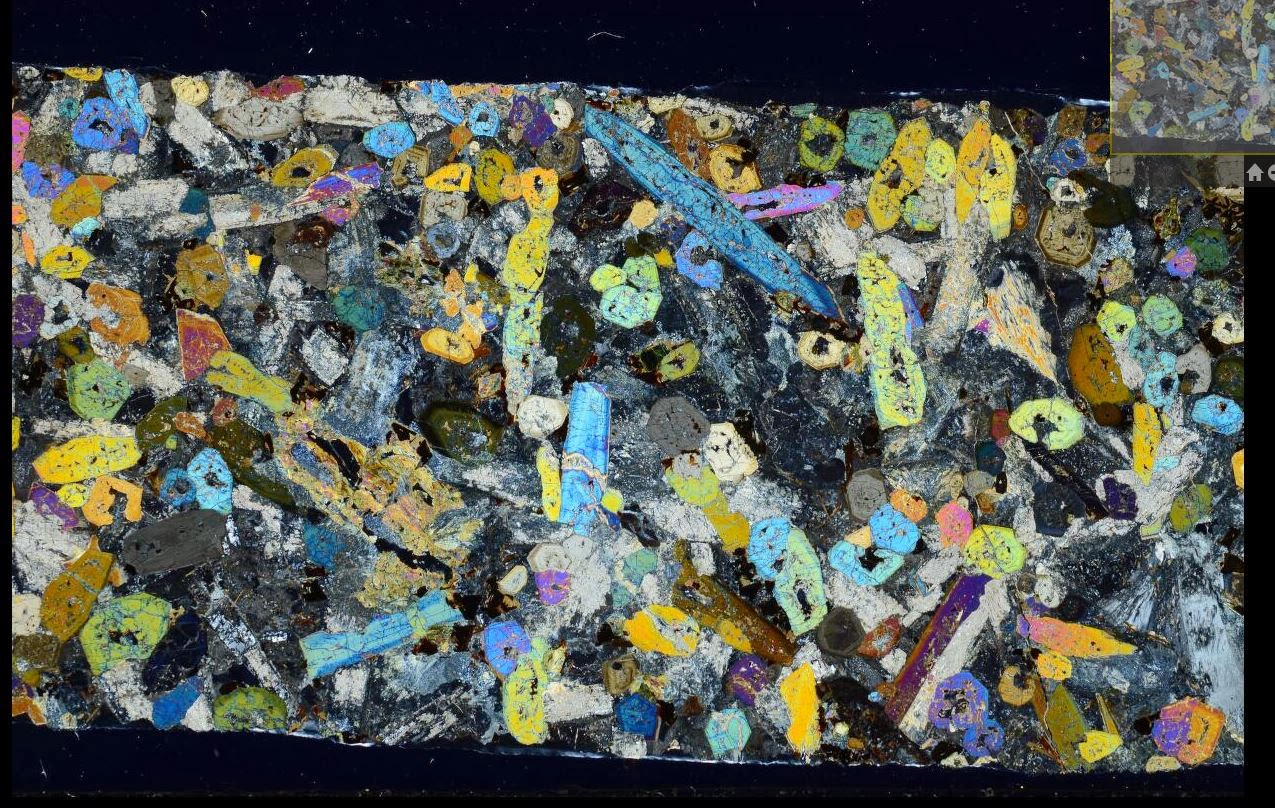
BGS Thin section number: N10550. Lugar Drill Hole No.3, N bank of Glenmuir Water just up stream with Bellow Water, depth: from 18.8 inch section to 12ft 1 inches.
BGS Thin section number: N10554. Lugar Drill Hole No.3, N bank of Glenmuir Water just up stream with Bellow Water, depth: from 12.8 inch section to 14ft 1 inches.
The petrological thin sections (microscope slides) are being digitally photographed (plane and cross polarized light) and progressively linked to the database. Currently about 110,000 Scottish thin sections are available (220,000 images) (S & N registration series). The English collection is currently being captured and the first images will be available on Britrocks during 2014. To view others in the collection visit Britrocks, the British Geological Survey online catalogue of rock and mineral samples.
To see how the images have been captured by our team of volunteers visit this blog post on Geoblogy by Isla Simmons and Rachel Whitty.
Bob McIntosh
SILEX granatus. Garnet. Plate no. 44. From: Sowerby, James. 1802-1817. British Mineralogy: Or Coloured figures intended to elucidate the mineralogy of Great Britain. Plate from vol: 1. page no.92. Modern name: Garnet.
Rock specimen of garnet pegmatite. Loch Garve, Garve, Rosshire, Scotland. The photograph is a detail of the surface of a garnet pegmatite sample, characterized by ruby-red spherical garnets of varying sizes, within a matrix of pale quartz and white mica. British Geological Survey Petrology Collection sample number EMC589. Garnets of this colour are generally rich in iron and manganese, termed 'almandine' garnets. The pegmatites in the Garve area have been dated using radiometric dating techniques, which indicate they are Precambrian in age.
Photomicrograph of garnet-mica schist. Light: XPL, Magnification x 2. Glen Roy half a mile north-east of Stone and east of Beinn a' Monicag, Invernessshire. The image is a photomicrograph taken under crossed-polarizing lenses of a thin section of garnet mica-schist. British Geological Survey Petrology Collection sample number S 82420. Light: XPL, Magnification x 2. Light: XPL, Magnification x 2. The sample comes from the Monadhliath Mountains of the Grampian Highlands of Scotland. It is a semipelitic rock (a metamorphosed siltstone or impure sandstone) of Precambrian age which has become completely recrystallized with the development of an assemblage of metamorphic minerals. As the original sedimentary rocks become deeply buried in the Earth's crust they undergo a series of profound changes which, under the effects of elevated temperature and pressure, result in the breakdown of the original sedimentary minerals and the growth of new metamorphic minerals. This specimen is from the Leven Schist Formation, Appin Group, Dalradian Supergroup (Precambrian) from Glen Roy, half a mile north-east of Stone and east of Beinn a' Monicag. This formation consists of laminated, pale grey, pelitic schists which are locally flaggy and variably garnetiferous with thin carbonate beds towards the top of the formation. Following the progressive shallowing associated with the Grampian Group basin there was slow subsidence resulting in a marine transgression which led to the deposition of the Lochaber Subgroup. This was followed by a significant increase in water depth which led to the deposition of the Leven Schist Formation.
Bob McIntosh
Tamrin fossil tree; Microscope slide from the Sir Joseph D. Hooker Collection, BGS.
This slide is of piece of fossil wood from Tasmania collected by Hooker in 1840. The Expedition leader, James Clark Ross recorded that the fossil trees were found encased in ancient lava flows and were preserved as 'most beautiful agate'. Age: Tertiary Period, 40 million years old.
From Collection A: Joseph Dalton Hooker collection. Hooker's collection comprises material collected during his 1839-1843 circum-Antarctic voyage in HMS Erebus and HMS Terror.
Bob McIntosh