Showing posts with label geomagnetism. Show all posts

Tuesday, 30 August 2016

Isla Observatorio, Tierra del Fuego geomagnetic observatory 1902-1917

 Isla Observatorio, Tierra del Fuego lighthouse

A chance discovery among some photographs in the BGS Geomagnetic archive included this interesting image of a lighthouse. After much searching, this was identified as the Isla Observatorio at the southern tip of Argentina.

The following photograph is a good match for the fifth photo down on this history of the island, further evidence that this set of photographs is indeed the observatory on Isla Observatorio.

 Isla Observatorio, Tierra del Fuego geomagnetic observatory

The Observatory was run by Lieutenant Commander Horacio Ballvé, who may be among the people pictured in the photo below.
Group photograph,  Isla Observatorio, Tierra del Fuego geomagnetic observatory

The following show the inside of the magnetic observatory with some of the instruments.
 Isla Observatorio, Tierra del Fuego geomagnetic observatory, instrument

 Isla Observatorio, Tierra del Fuego geomagnetic observatory, instruments

 Isla Observatorio, Tierra del Fuego geomagnetic observatory, instruments


 Isla Observatorio, Tierra del Fuego geomagnetic observatory, instruments

Lastly are two photographs, one showing a small ship and the other a beach with southern sea lions.
 Isla Observatorio, Tierra del Fuego geomagnetic observatory, ship


 Isla Observatorio, Tierra del Fuego, southern sea lions

HISTAMAR Las expediciones de investigacion arqueologica de Carlos P. Vairo y el Museo Maritimo de Ushuaia. Faro de isla Año Nuevo, Monumento Nacional Dec.64/99.

Grondona, Vero  La isla de los estados y la Isla Observatorio, Tierra del Fuego

Posted by Bob McIntosh, image processing Fergus MacTaggart, historical advice by Dr. Phil Stone


Thursday, 18 September 2014

Franklin's Ships: Records from HMS Erebus and HMS Terror

‘Term day books’ from HMS Erebus and HMS Terror, 1840-1842, containing both magnetic and meteorological observations

‘Term day books’ from HMS Erebus and HMS Terror, 1840-1842, containing both magnetic and meteorological observations.


Sir John Franklin’s fabled lost expedition, back in the news last week after one of the ships was found by Canadian search vessels, was not the first time that the two ships HMS Erebus and HMS Terror set sail together on a voyage of exploration. Six years before Erebus and Terror departed England for the Arctic, they were beginning a four year expedition that would take them southwards to the Antarctic. On that journey they were led by Captain James Clark Ross, an experienced polar explorer, with the second in command (and commander of HMS Terror) being Francis Crozier. Crozier was captain of the same ship on Franklin’s expedition, and is reported to have taken charge after Franklin’s death, with some suggestions that he survived for several years afterwards. 

One of the aims of both Ross’s Antarctic expedition and Franklin’s Arctic one was to collect magnetic data, and the data relating to the Antarctic can still be found in BGS’s collections today. Both HMS Erebus and HMS Terror recorded information relating to the earth’s magnetic field, as well as making meteorological observations such as details of aurora sightings. BGS holds similar records of many other Royal Navy ships, with data collected around the world throughout the nineteenth and early twentieth centuries. A list of Royal Navy ships’ geomagnetic log books held by BGS can be found here. Records of Ross’s expedition also live on in the names of many Antarctic landmarks – for example the Ross Ice Shelf, Ross Sea, and Ross Island with its two volcanoes Mount Erebus and Mount Terror.

See below for more images of records from HMS Erebus and HMS Terror.


Term day book and other papers containing magnetic and meteorological observations from HMS Erebus, 1840-1843. James Ross’s signature can be seen in the centre.

Term day book and other papers containing magnetic and meteorological observations from HMS Erebus, 1840-1843. James Ross’s signature can be seen in the centre.


Magnetic observations taken at Auckland Island (to the south of New Zealand), 5th December 1840, and Van Diemen’s Land (now Tasmania), May 1841, from HMS Erebus

Magnetic observations taken at Auckland Island (to the south of New Zealand), 5th December 1840, and Van Diemen’s Land (now Tasmania), May 1841, from HMS Erebus.

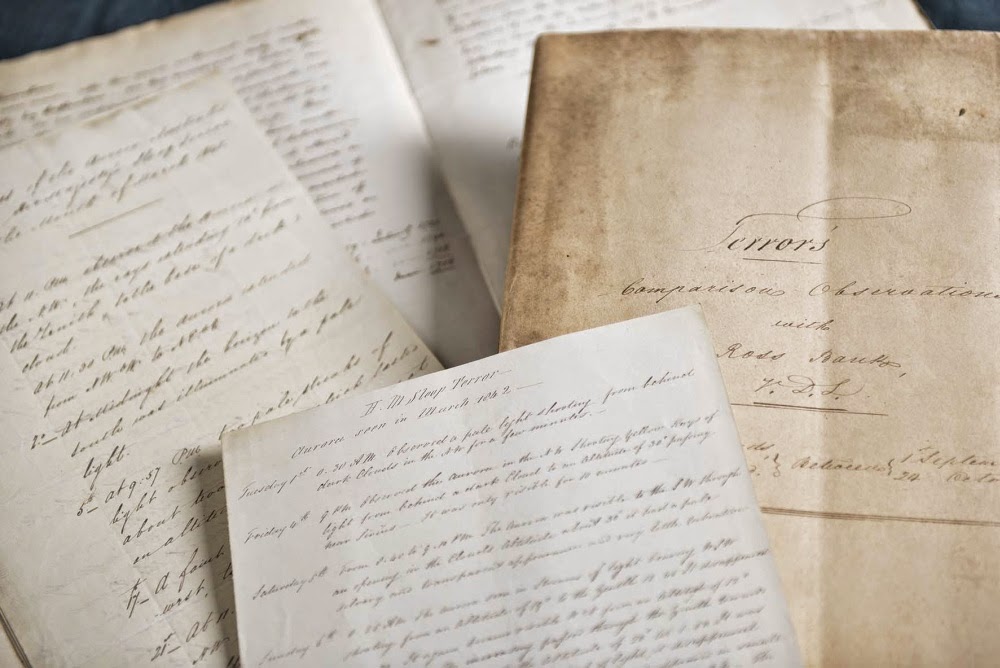
Papers from HMS Terror, 1841-1842. The document on the right compares magnetic observations from HMS Terror with those made at Ross Bank, Tasmania.

Papers from HMS Terror, 1841-1842. The document on the right compares magnetic observations from HMS Terror with those made at Ross Bank, Tasmania. 


Francis Crozier’s signature on a document recording auroras seen from HMS Terror in March 1842

Francis Crozier’s signature on a document recording auroras seen from HMS Terror in March 1842.

Saturday, 25 May 2013

The Carrington event, the largest magnetic storm on record. August 27th to September 7th, 1859

The Carrington event - the largest magnetic storm on record. August 27th to September 7th, 1859. Recorded at Greenwich Observatory, London.
BGS Magnetogram image ID 188878
The Carrington event - the largest magnetic storm on record. August 27th to September 7th, 1859. Recorded at Greenwich Observatory, London.

The event was responsible for a great auroral storm. The following is an eyewitness account from a woman on Sullivan's Island, Carolina and reported in the Charleston Mercury:

“The eastern sky appeared of a blood red color. It seemed brightest exactly in the east, as though the full moon, or rather the sun, were about to rise. It extended almost to the zenith. The whole island was illuminated. The sea reflected the phenomenon, and no one could look at it without thinking of the passage in the Bible which says, ‘the sea was turned to blood.’ The shells on the beach, reflecting light, resembled coals of fire.”

BGS has scanned its full collection of 300,000 magnetograms. Full resolution images can be found at http://www.bgs.ac.uk/data/magnetograms/

Bob McIntosh