Showing posts with label slate. Show all posts

Sunday, 4 May 2014

Broughton Moor near Coniston, Cumbria - slate working

 Broughton Moor, Lakeland Green Slate, 7 miles south-west of Coniston, Cumbria. Excavator level - NCK 304 excavator.
BGS Image ID: P538078
Broughton Moor, Lakeland Green Slate, 7 miles south-west of Coniston, Cumbria. Excavator level - NCK 304 excavator.

Broughton Moor. Green Slate Quarries, Spout Crag Quarry, 7 miles south-west of Coniston, Cumbria. Loading a large block in the quarry - NCK 304.
BGS Image ID: P538063
Broughton Moor. Green Slate Quarries, Spout Crag Quarry, 7 miles south-west of Coniston, Cumbria. Loading a large block in the quarry - NCK 304.

Broughton Moor, Lakeland Green Slate, 7 miles south-west of Coniston, Cumbria. Circular saw - Anderson saw.
BGS Image ID: P538093
Broughton Moor, Lakeland Green Slate, 7 miles south-west of Coniston, Cumbria. Circular saw - Anderson saw.

Broughton Moor, Lakeland Green Slate, 7 miles south-west of Coniston, Cumbria. Trimming roofing slate
BGS Image ID: P538101
Broughton Moor, Lakeland Green Slate, 7 miles south-west of Coniston, Cumbria. Trimming roofing slate

Broughton Moor, Lakeland Green Slate, 7 miles south-west of Coniston, Cumbria. Slab riving.
BGS Image ID: P538105
Broughton Moor, Lakeland Green Slate, 7 miles south-west of Coniston, Cumbria. Slab riving.

Broughton Moor, Lakeland Green Slate, 7 miles south-west of Coniston, Cumbria. Polishing
BGS Image ID P538115
Broughton Moor, Lakeland Green Slate, 7 miles south-west of Coniston, Cumbria. Polishing

The photographs are part of a large collection donated by Mr. Hugh O'Neill, former Special Correspondent for Quarry Manager Journal and Cement, Lime and Gravel in the early 1960s. The full set of Broughton Moor slate working images can be viewed on the BGS Geoscenic. image resource.

There may be discrepancies with some of the stated locations e.g. P538063 is listed as Spout Crag Quarry which was in Langdale not Broughton Moor.

Posted by Bob McIntosh

Monday, 25 November 2013

Letter from Charles Darwin to Trenham Reeks

Letter from Charles Darwin to Trenham Reeks (Page 1 of 3)
BGS image ID: P883129
 
Letter from Charles Darwin to Trenham Reeks (Page 2 of 3)
BGS image ID: P883130
 
Letter from Charles Darwin to Trenham Reeks (Page 3 of 3)
BGS image ID: P883131

This letter from Charles Darwin to Trenham Reeks was written on 13 August 1858 and concerns some slate reliefs that Darwin wanted to sell. The letter has been transcribed as part of the Darwin Correspondence Project and can be read here .

Andrew L Morrison

http://www.exploreyourarchive.org/

Sunday, 24 November 2013

Three Scottish building stone specimens

Rock specimen of sandstone from Bloody Mires Quarry, Kippen Muir, Central Region, Scotland.  Sample of red sandstone, showing uniform grainsize and colour. This specimen is of Devonian age. British Geological Survey Petrology Collection sample number MC2092. This sample is from an abandoned quarry which may have been used for local building stone. Red sandstone was commonly used in Scotland from the late 19th century. The largest and most significant quarries of red sandstone in Scotland were in Ayrshire and Dumfriesshire, from where the stone was transported by railway.
BGS Image ID: P519461
Rock specimen of sandstone from Bloody Mires Quarry, Kippen Muir, Central Region, Scotland.

Sample of red sandstone, showing uniform grainsize and colour. This specimen is of Devonian age. British Geological Survey Petrology Collection sample number MC2092. This sample is from an abandoned quarry which may have been used for local building stone. Red sandstone was commonly used in Scotland from the late 19th century. The largest and most significant quarries of red sandstone in Scotland were in Ayrshire and Dumfriesshire, from where the stone was transported by railway.


Rock specimen of sandstone from Hailes Quarry, Edinburgh, Lothian Region, Scotland.   Oblique photograph of a specimen of Hailes sandstone, with the name of the quarry carved on one side. This specimen is of Carboniferous age. British Geological Survey Petrology Collection sample number MC1318. The upper surface has been left in its natural state, showing the uneven bedding surface. Such samples were prepared by the quarry in order to market the stone. This sample dates from before the First World War. Size of specimen: 11x11x5 cm. Munsell colour code and colour 5YR8/1, pinkish grey.
BGS Image ID: P519533
Rock specimen of sandstone from Hailes Quarry, Edinburgh, Lothian Region, Scotland.

Oblique photograph of a specimen of Hailes sandstone, with the name of the quarry carved on one side. This specimen is of Carboniferous age. British Geological Survey Petrology Collection sample number MC1318. The upper surface has been left in its natural state, showing the uneven bedding surface. Such samples were prepared by the quarry in order to market the stone. This sample dates from before the First World War. Size of specimen: 11x11x5 cm. Munsell colour code and colour 5YR8/1, pinkish grey.


Specimen of roofing slate quarried from Easdale Island, Argyllshire, Scotland This slate shows the trade mark stamp of the Easdale Slate Company. The specimen is of Precambrian, Dalradian age. British Geological Survey Petrology Collection sample number EMC 5736. The slate is a typical dark grey colour with a strong 'grain' and containing pyrite crystals. This specimen was donated to the Geological Survey of Scotland sometime before 1916. For hundreds of years slate was the preferred roofing material in Scotland. The geological variation found in slate quarries from across Scotland meant that each produced a characteristic slate, with a colour, texture and thickness varying from region to region.
BGS Image ID: P519560
Specimen of roofing slate quarried from Easdale Island, Argyllshire, Scotland

This slate shows the trade mark stamp of the Easdale Slate Company. The specimen is of Precambrian, Dalradian age. British Geological Survey Petrology Collection sample number EMC 5736. The slate is a typical dark grey colour with a strong 'grain' and containing pyrite crystals. This specimen was donated to the Geological Survey of Scotland sometime before 1916. For hundreds of years slate was the preferred roofing material in Scotland. The geological variation found in slate quarries from across Scotland meant that each produced a characteristic slate, with a colour, texture and thickness varying from region to region.

Bob McIntosh

Friday, 12 April 2013

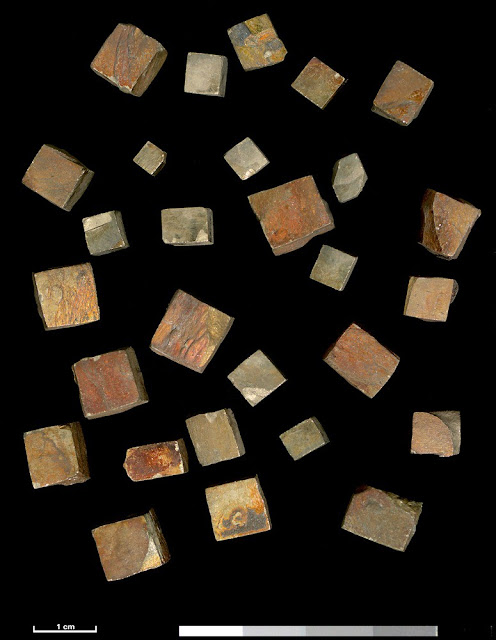
Mineral specimen of pyrite. Cuan Slate Quarry, Luing, Argyllshire

Mineral specimen of pyrite. Cuan Slate Quarry, Luing, Argyllshire.  The image shows a number of near-perfect cubic crystals of pyrite. They have a variable colour and are stained with yellow and orange colours due to the presence of secondary iron oxide minerals on the crystal surfaces. When fresh pyrite has a metallic brass-yellow colour.
BGS image ID: P521549
Mineral specimen of pyrite. Cuan Slate Quarry, Argyllshire.

The image shows a number of near-perfect cubic crystals of pyrite. They have a variable colour and are stained with yellow and orange colours due to the presence of secondary iron oxide minerals on the crystal surfaces. When fresh pyrite has a metallic brass-yellow colour. 

Crystals of pyrite such of this are common in the slate deposits of the Easdale area. They were referred to as 'diamonds' by the quarrymen, although economically they are practically worthless. Pyrite is an iron sulphide mineral belonging to the cubic crystal system that occurs as striated, cubic, octahedral or pyritohedral crystals. These specimens come from a small quarry in the 25-ft raised-beach platform 150 yards from the quay at Cuan Ferry at the north end of Luing. The thicker seam contains a bluish-grey slate with fairly large pyrites crystals, although the crystals usually cleave through, and do not pull out when the slate is split. The other seam lies immediately west of the thicker seam. It is a darker slate and rather softer in quality, with very small pyrites crystals. The slate and pyrites belong to the Dalradian Supergroup (Precambrian) Easdale Slate, predominantly black carbonaceous pyritic slates.

Bob McIntosh