Showing posts with label portland. Show all posts

Sunday, 19 April 2015

Working Portland Stone

Easton, Bath and Portland Stone Firms, Ltd., Portland. General view of mason's workshop in Portland Stone works. Works of Bath and Portland Stone Firms, Ltd. 1930.
BGS Image ID: P023985
Easton, Bath and Portland Stone Firms, Ltd., Portland. General view of mason's workshop in Portland Stone works. Works of Bath and Portland Stone Firms, Ltd. 1930.

Easton Quarry, Isle of Portland, Dorset. There are several quarries in the Easton area working the white freestone limestones known as Portland Stone. In the early 19th century, when many of the quarries were still in the hands of the Crown, they were principally worked by convict labour. Large stone columns are a feature of most classical stone buildings and in later times many British architects copied such classical themes. Portland Stone proved to be ideal for this purpose because the beds of limestone are quite thick. Here a section of stone column is being turned on lathe at the works of the Bath & Portland Stone Company. The section is of 4 ft. diameter, and is one of five constituting a column 25 ft. high. As Portland Stone seems to be less affected by pollution than other United Kingdom limestones it has been widely used in London, particularly since the early 19th century e.g. Custom House, St. Paul's Cathedral, The Bank of England, Whitehall and Downing Street.
BGS Image ID: P204941
Easton Quarry, Isle of Portland, Dorset. There are several quarries in the Easton area working the white freestone limestones known as Portland Stone. In the early 19th century, when many of the quarries were still in the hands of the Crown, they were principally worked by convict labour. Large stone columns are a feature of most classical stone buildings and in later times many British architects copied such classical themes. Portland Stone proved to be ideal for this purpose because the beds of limestone are quite thick. Here a section of stone column is being turned on lathe at the works of the Bath & Portland Stone Company. The section is of 4 ft. diameter, and is one of five constituting a column 25 ft. high. As Portland Stone seems to be less affected by pollution than other United Kingdom limestones it has been widely used in London, particularly since the early 19th century e.g. Custom House, St. Paul's Cathedral, The Bank of England, Whitehall and Downing Street.

Easton, Bath and Portland Stone Firms, Ltd., Portland. Hand-carving in Portland Stone. Only straightforward work such as that on ashlar and on mouldings is carried out by machine. Finer work is all done by hand. Works of Bath and Portland Stone Firms, Ltd.
BGS Image ID: P204947
Easton, Bath and Portland Stone Firms, Ltd., Portland. Hand-carving in Portland Stone. Only straightforward work such as that on ashlar and on mouldings is carried out by machine. Finer work is all done by hand. Works of Bath and Portland Stone Firms, Ltd.

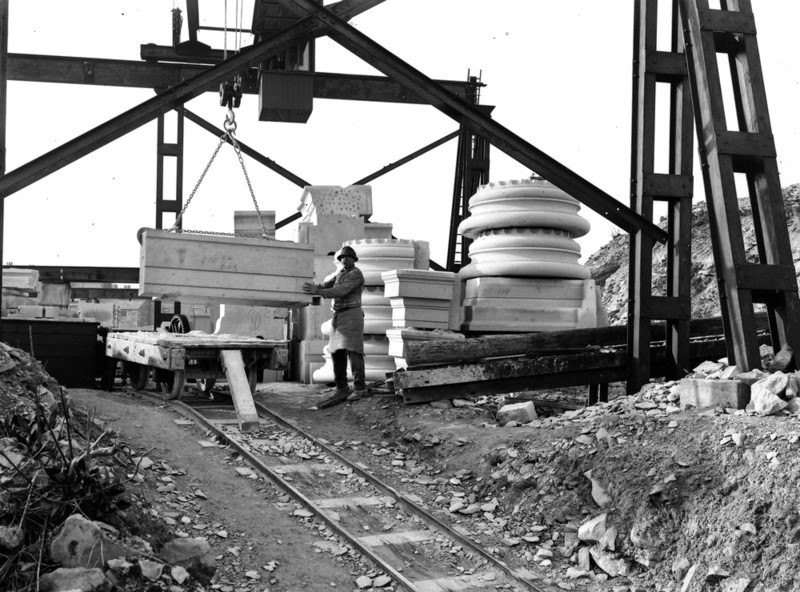
Easton, Bath and Portland Stone Firms, Ltd., Portland. Travelling crane lifting block of masonry in Portland Stone. Works of Bath and Portland Stone Firms, Ltd.
BGS Image ID: P204950
Easton, Bath and Portland Stone Firms, Ltd., Portland. Travelling crane lifting block of masonry in Portland Stone. Works of Bath and Portland Stone Firms, Ltd.

Easton, Bath and Portland Stone Firms, Ltd., Portland. Stack of finished masonry in Portland Stone. The diameter of sections of fluted columns in foreground is 4 ft. Works of Bath and Portland Stone Firms, Ltd.
BGS Image ID: P204951
Easton, Bath and Portland Stone Firms, Ltd., Portland. Stack of finished masonry in Portland Stone. The diameter of sections of fluted columns in foreground is 4 ft. Works of Bath and Portland Stone Firms, Ltd.

Posted by Bob McIntosh

Tuesday, 14 May 2013

Stone mason working on a capital, Bath & Portland Stone Firms Ltd.

Stone mason at work on a capital, Bath & Portland Stone Firms Ltd., West Wells Masonry Works, Corsham.
BGS image No: P539472
Stone mason at work on a capital, Bath & Portland Stone Firms Ltd., West Wells Masonry Works, Corsham.  From the Hugh O'Neill Collection. Date: c. 1961.

Bob McIntosh

Sunday, 24 March 2013

Steam traction engine pulling 10 ton blocks of Portland Stone

Easton, Portland. Looking SW. Transport of Portland Stone from quarries. Much stone is shipped from Portland and blocks up to 10 tons in weight are drawn by traction engine
BGS image ID: P023972
The Bath & Portland Stone Firms Ltd. Easton, Portland. Looking SW. Transport of Portland Stone from quarries. Much stone is shipped from Portland and blocks up to 10 tons in weight are drawn by traction engine from the quarries to the head of a special railway leading from the highest point of the Island to the quay.

Photographer: Rhodes, J.
Date of photograph: 1930.

R.P. McIntosh

Tuesday, 19 March 2013

St. Paul's Quarry, Isle of Portland, Dorset.

St. Paul's Quarry, Isle of Portland, Dorset.  Splitting a block using 'plug and feather'
BGS image ID: P023964
St. Paul's Quarry, Isle of Portland, Dorset. Splitting a block with a technique called 'plug and feather'.

Stone has been worked on the Isle of Portland since ancient times for building and ornamental purposes. The commonly known Purbeck Marble is not a true marble but a polished fossiliferous limestone that contains the fossil shells of tiny water snails (the gastropod viviparus). The Purbeck rocks were deposited in the Jurassic and Cretaceous geological periods from about 155 to 45 million years ago. The quarrymen had their own terms for the various beds they came across. Rag stone, at the top was described as crumbly and very good; Grub, a fine bed able to produce fine paving stones and would take a polish; Roach, followed by Thornback would produce a 'blue hued stone'. At the base is the Freestone and above that the Whetson. The stone was both quarried and mined, both dangerous occupations. The limestone quarries of Portland Bill have been in operation since Roman times. The characteristic white limestones which have proved to be extremely durable, even in the most polluted of urban environments, can be found in important buildings in all major cities and most large towns in the United Kingdom.

Date of photograph: 1930. Photographer: Jack Rhodes. Original BGS photograph number: A4987.